
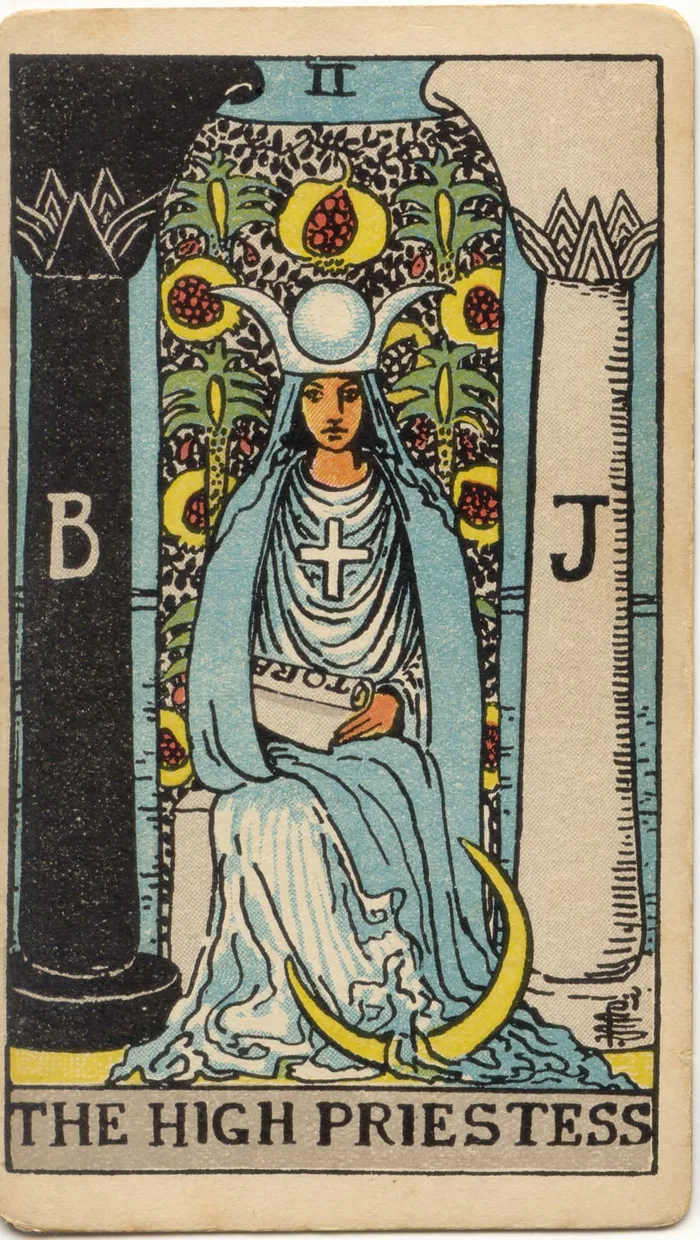
 The High Priestess
Reflection, in context.
Give uncertainty space. Separate private impressions from facts you can check.
Card imagery and meaning
The card shows a figure sitting between two contrasting pillars, with a veil behind her and a scroll in her lap.
The image is a scan of the original 1909 deck illustrated by Pamela Colman Smith. Separate what you can observe in the drawing from the interpretation you bring to it. The questions below are modern reflection exercises.
Upright and reversed meanings
The reversed meanings below are modern reflection prompts rather than a single traditional rule. Our card-drawing tool uses upright cards only.
More columns → Swipe sideways, or focus the table and use the arrow keys.
| Orientation | A useful lens | Before you interpret |
|---|---|---|
| Upright | Give uncertainty space. Separate private impressions from facts you can check. | Does this question match the facts of your situation? |
| Reversed | Ask whether silence is giving you room to reflect or helping an unanswered question stay hidden. | Look for too much of this quality, too little of it, or a different angle. Do not simply flip the upright meaning into its opposite. |
Look closer at the card
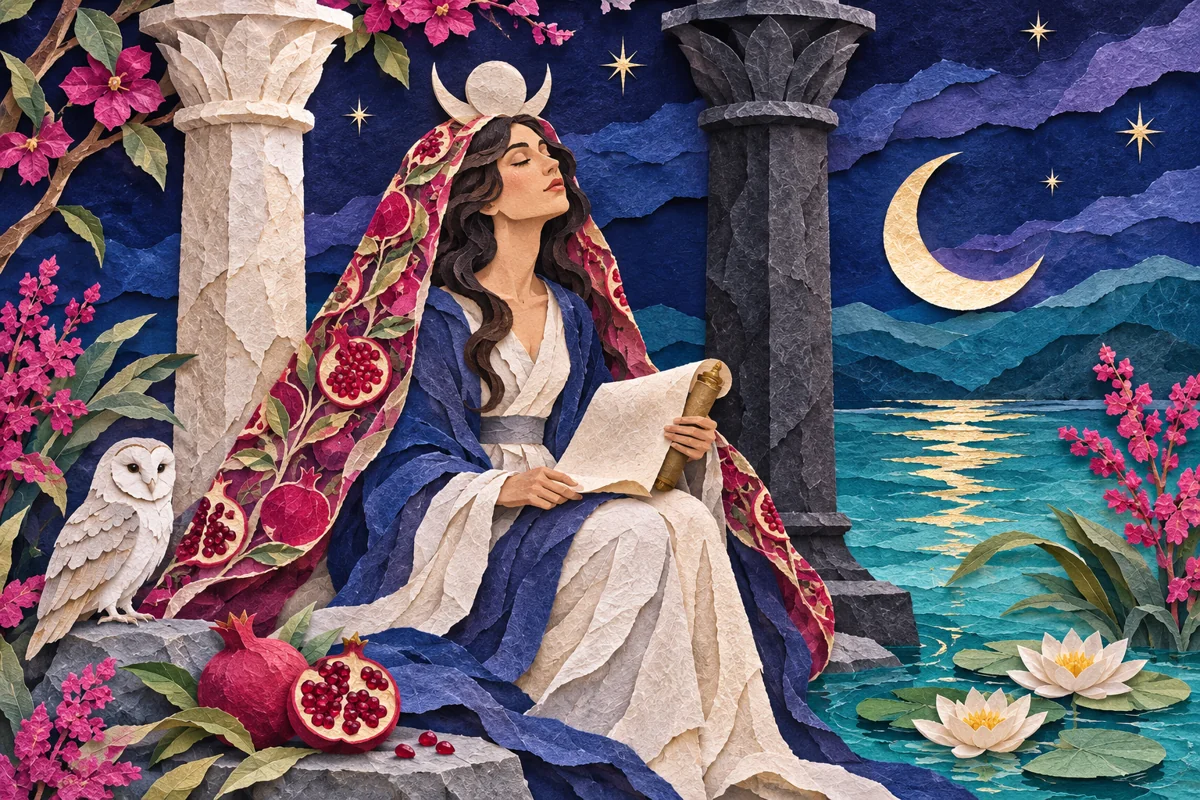
Card imagery and meaning
The card shows a figure sitting between two contrasting pillars, with a veil behind her and a scroll in her lap.
Read the spread position alongside the card
More columns → Swipe sideways, or focus the table and use the arrow keys.
| Position | Question to explore | What to record alongside it |
|---|---|---|
| Situation | What do I know, and what am I filling in? | Write down the specific fact or event that prompted your question. |
| Obstacle | Could the theme of reflection be overemphasised, neglected or simply irrelevant? | Several interpretations may fit, or none at all. |
| Action | Read the brief and gather the missing information before committing. | Pick a low-risk action you can undo, and watch what happens. |
| Reflection | How did your understanding of reflection change? | Compare your original notes with what actually happened. |
Practice scenario
Fictional situation: A collaborator sends an intriguing invitation with little detail.
Try this: Make three columns: what was said, what you inferred, and what you still need to ask. Ask for the missing scope before you agree.
Check the interpretation: What do I actually know, and what am I filling in? If this theme doesn't fit, set it aside. You don't have to force every card you draw into an explanation.
This is a fictional exercise to distinguish known facts from personal assumptions.
- Three Column Method
Create columns for what was said, your personal inference, and required questions to clarify the missing project scope before you commit.
- Verify Your Interpretation
Assess if your conclusion is based on actual information or your own filling in of gaps. Set aside themes that do not fit.
Relationships and work
Relationships: An intuition is a reason to ask carefully, not proof of what someone secretly feels.
Work and practice: Read the brief and gather the missing information before committing.
Compare The High Priestess with The Moon
Both can prompt reflection on uncertainty; neither confirms a suspicion.
Read The MoonQuick exercise
State the facts of your situation in one sentence. Then ask yourself: “What do I know, and what am I filling in?” In your answer, underline every inference that isn't a direct observation.
See an example of fact vs. assumption +
“The deadline changed” is an observation. “This means my work is not valued” is an interpretation. That thought might be worth discussing, but a tarot card cannot prove it is true.