
 The Magician
Practical Resource Assessment
Notice what you can already put to use: a skill, a tool, a conversation or some time.
Card imagery and meaning
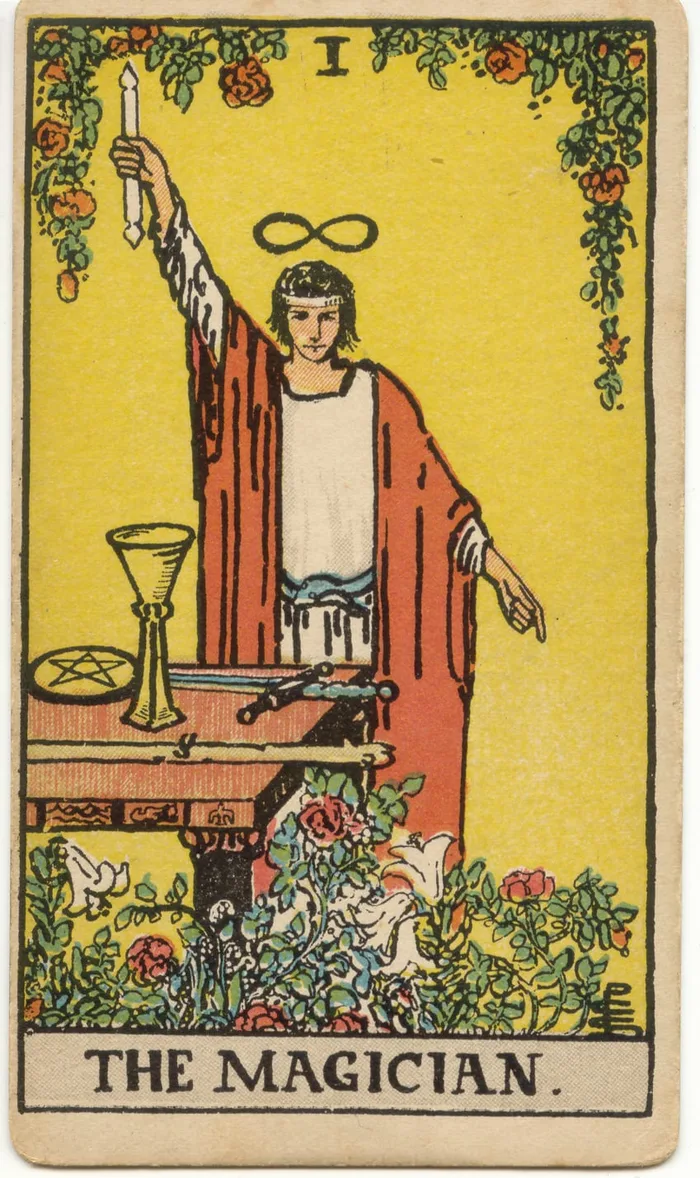
A figure stands at a table displaying tools for the four tarot suits, with one hand pointed toward the sky and the other toward the earth.
The image is a scan of the original 1909 deck illustrated by Pamela Colman Smith. Separate what you can observe in the drawing from the interpretation you bring to it. The questions below are modern reflection exercises.
Upright and reversed meanings
The reversed meanings below are modern reflection prompts rather than a single traditional rule. Our card-drawing tool uses upright cards only.
More columns → Swipe sideways, or focus the table and use the arrow keys.
| Orientation | A useful lens | Before you interpret |
|---|---|---|
| Upright | Notice what you can already put to use: a skill, a tool, a conversation or some time. | Does this question match the facts of your situation? |
| Reversed | Consider whether confidence exceeds preparation, or whether useful abilities are being left unused. | Look for too much of this quality, too little of it, or a different angle. Do not simply flip the upright meaning into its opposite. |
Look closer at the card
Card imagery and meaning
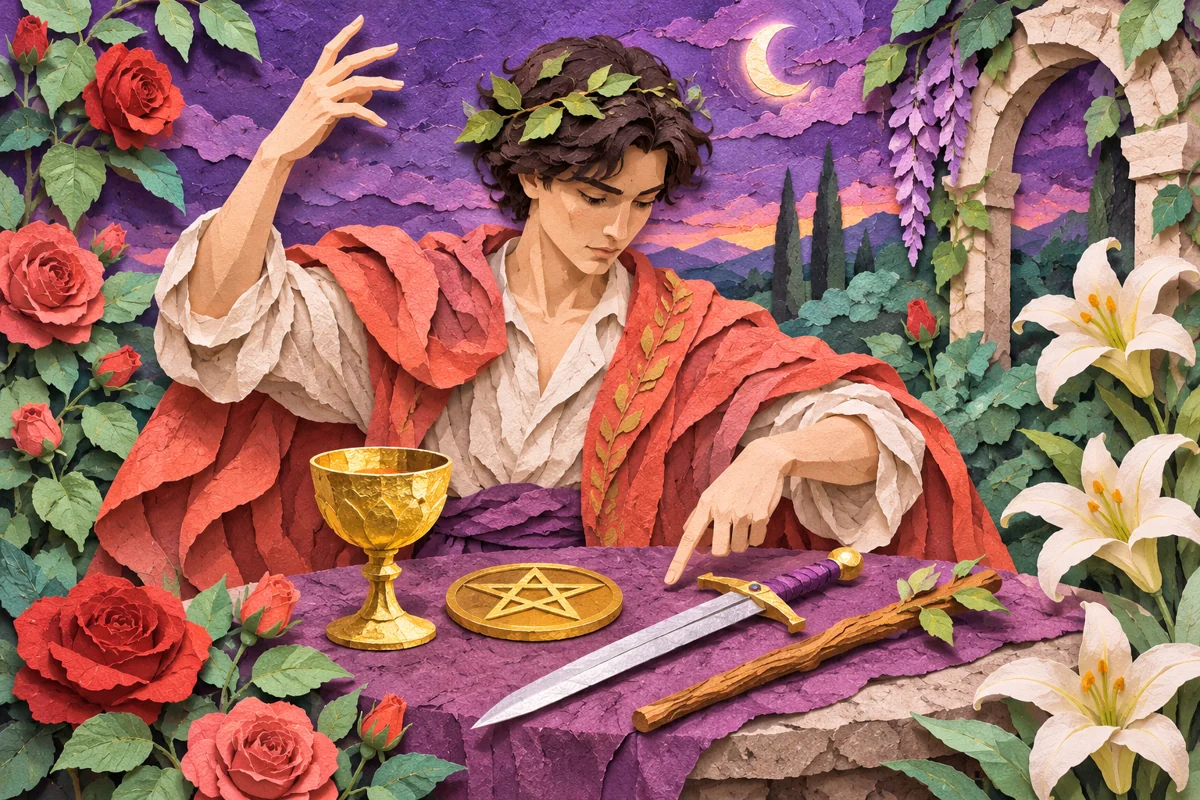
A figure stands at a table displaying tools for the four tarot suits, with one hand pointed toward the sky and the other toward the earth.

Read the spread position alongside the card
More columns → Swipe sideways, or focus the table and use the arrow keys.
| Position | Question to explore | What to record alongside it |
|---|---|---|
| Situation | Which available resource have I overlooked? | Write down the specific fact or event that prompted your question. |
| Obstacle | Is the focus on resources excessive, ignored, or irrelevant? | Several interpretations may fit, or none at all. |
| Action | Differentiate between a proven skill and a mere promise. | Pick a low-risk action you can undo, and watch what happens. |
| Reflection | How has your perspective on resources shifted? | Compare your original notes with what actually happened. |
Practice scenario
Fictional situation: You have a workshop concept but are delaying action until you acquire better equipment.
Try this: List your current room, tools, and knowledge. Run a ten-minute test session with a friend.
Check the interpretation: Ask yourself: Which available resource have I overlooked? If this topic does not apply, skip it. You are not required to force every card to fit your situation.
An illustrative learning summary for a fictional workshop scenario.
- Identify current assets
Instead of waiting for new equipment, document the room, tools, and knowledge you possess right now to start your project.
- Conduct brief test
Perform a ten-minute trial session with a friend to observe how your concept functions using your existing, limited resources.
- Review resource usage
Consider whether you have overlooked available tools and determine if the card's theme applies to your specific situation.
Relationships and work
Relationships: Identify your own contributions rather than attempting to manage the other person’s reaction.
Work and practice: Differentiate between a proven skill and a mere promise.
Compare The Magician with The Chariot
Resources provide the means for action; your sense of direction dictates the outcome.
Read The ChariotQuick exercise
State the facts of your situation in one sentence. Then ask: “Which available resource have I overlooked?” Underline any inferences that are not direct observations.
See an example of fact vs. assumption +
“The deadline changed” is an observation. “This means my work is not valued” is an interpretation. That thought might be worth discussing, but a tarot card cannot prove it is true.