
 The Moon
Ambiguity in context
Give more than one explanation a fair hearing when information is incomplete.
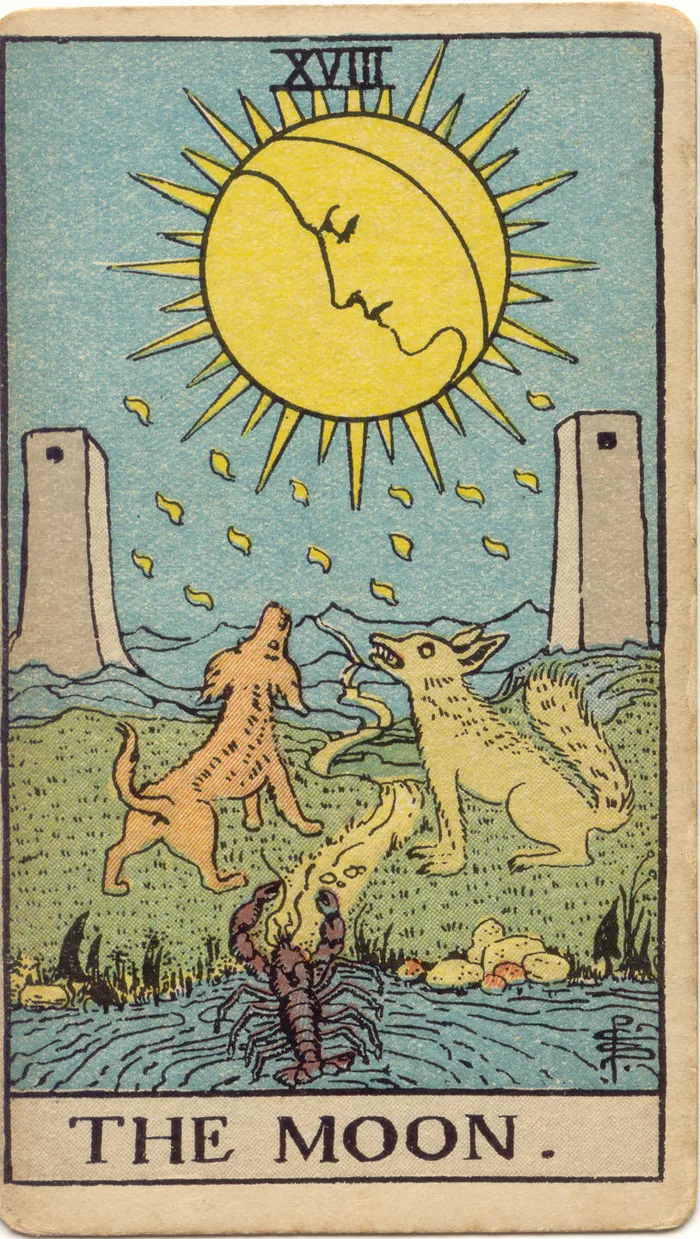
Four details in the 1909 illustration
The moon and reflected light: In the 1909 Pamela Colman Smith illustration, the moon shines with reflected light above the landscape. As a contemporary prompt, ask which part of your situation you are seeing only indirectly.
The dog and the wolf: Waite points out a dog and a wolf in the foreground. As a contemporary prompt, consider how familiar habits and raw fears both react when you lack clear facts.
The two towers and the path: A path winds between two towers into the distance. As a contemporary prompt, separate the part of your plan that is already defined from the stretch that remains unknown.
The crayfish and the water: A crayfish crawls out from the pool at the bottom of the card. As a contemporary prompt, notice which half-formed worry has just surfaced and write it down before acting on it.
Card imagery and meaning
A moon hangs above a path, two towers, and animal figures near water.
The image is a scan of the original 1909 deck illustrated by Pamela Colman Smith. Separate what you can observe in the drawing from the interpretation you bring to it. The questions below are modern reflection exercises.
Upright and reversed meanings
The reversed meanings below are modern reflection prompts rather than a single traditional rule. Our card-drawing tool uses upright cards only.
More columns → Swipe sideways, or focus the table and use the arrow keys.
| Orientation | A useful lens | Before you interpret |
|---|---|---|
| Upright | Give more than one explanation a fair hearing when information is incomplete. | Does this question match the facts of your situation? |
| Reversed | Check whether uncertainty is easing through evidence or merely being replaced by a preferred story. | Look for too much of this quality, too little of it, or a different angle. Do not simply flip the upright meaning into its opposite. |
Read the spread position alongside the card
More columns → Swipe sideways, or focus the table and use the arrow keys.
| Position | Question to explore | What to record alongside it |
|---|---|---|
| Situation | What else could explain what I noticed? | Write down the specific fact or event that prompted your question. |
| Obstacle | Could the theme of ambiguity be overemphasized, neglected, or simply irrelevant? | Several interpretations may fit, or none at all. |
| Action | Identify the information you need before acting on a suspicion. | Pick a low-risk action you can undo, and watch what happens. |
| Reflection | How did your understanding of ambiguity change? | Compare your original notes with what actually happened. |
Practice scenario
Fictional situation: An unclear message makes you imagine several possible meanings.
Try this: Write down two plausible interpretations and one direct question. Wait for an answer instead of treating your strongest feeling as proof.
Check the interpretation: Ask what else could explain what you noticed. If the theme does not fit, set it aside. You do not need to force every drawn card into an explanation.
This is a fictional exercise for clarifying ambiguous messages using The Moon card.
- Drafting Multiple Interpretations
Write two plausible interpretations for the message and one direct question. Avoid treating your strongest immediate feeling as confirmed proof.
- Verifying the Context
Ask what else could explain the message. If the theme does not fit your situation, set it aside.
Relationships and work
Relationships: A card cannot confirm deception, secret feelings, or a hidden relationship.
Work and practice: Identify the information you need before acting on a suspicion.
Compare The Moon with The High Priestess
CONTEMPORARY INTERPRETIVE COMPARISON
Both cards can point to uncertainty, and neither lets you read someone's mind.
Read The High PriestessQuick exercise
Write one sentence describing the facts of your situation. Then answer: “What else could explain what I noticed?” Underline anything in your answer that is an inference rather than a direct observation.
See an example of fact vs. assumption +
“The deadline changed” is an observation. “This means my work is not valued” is an interpretation. That thought might be worth discussing, but a tarot card cannot prove it is true.
What does The Moon card mean?
In a contemporary reading, The Moon tarot meaning centers on ambiguity, active imagination, and incomplete information. Drawing this card is not evidence that another person is deceiving you or hiding a secret.
Does The Moon predict something bad?
No. Tarot symbolism does not make reliable factual predictions about future events. Instead, the card helps you ask what information is still missing before you make a decision.
In practice, if an unanswered message makes you suspect the worst, the card is not proof of betrayal. It is a prompt to separate the delay you observed from the story you imagined.