
 Strength
Patience in context
Meet a difficult moment with patience and a clear boundary.
Card imagery and meaning
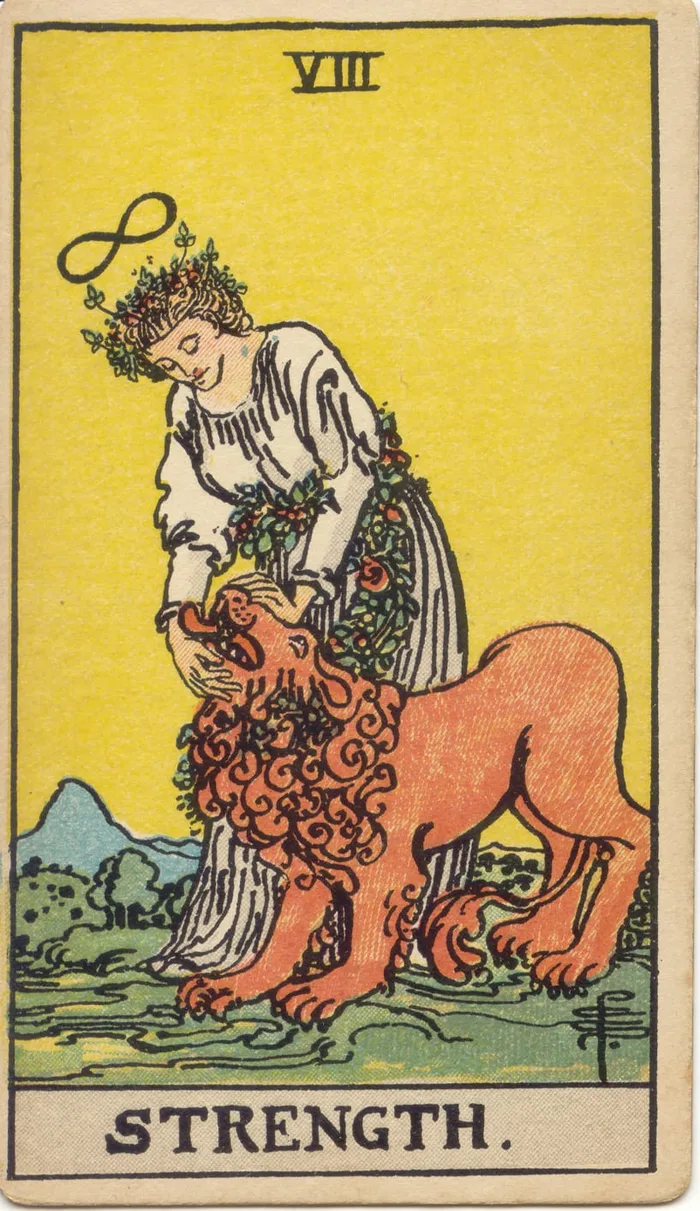
A figure calmly holds a lion beneath an infinity-shaped symbol.
The image is a scan of the original 1909 deck illustrated by Pamela Colman Smith. Separate what you can observe in the drawing from the interpretation you bring to it. The questions below are modern reflection exercises.
Upright and reversed meanings
The reversed meanings below are modern reflection prompts rather than a single traditional rule. Our card-drawing tool uses upright cards only.
More columns → Swipe sideways, or focus the table and use the arrow keys.
| Orientation | A useful lens | Before you interpret |
|---|---|---|
| Upright | Meet a difficult moment with patience and a clear boundary. | Does this question match the facts of your situation? |
| Reversed | Notice when exhaustion or self-criticism is being mistaken for a lack of courage. | Look for too much of this quality, too little of it, or a different angle. Do not simply flip the upright meaning into its opposite. |
Look closer at the card

Card imagery and meaning
A figure calmly holds a lion beneath an infinity-shaped symbol.

Read the spread position alongside the card
More columns → Swipe sideways, or focus the table and use the arrow keys.
| Position | Question to explore | What to record alongside it |
|---|---|---|
| Situation | What would a firm, calm response look like? | Write down the specific fact or event that prompted your question. |
| Obstacle | Is patience being overemphasized, neglected, or simply irrelevant here? | Several interpretations may fit, or none at all. |
| Action | Choose a sustainable response instead of proving how much strain you can tolerate. | Pick a low-risk action you can undo, and watch what happens. |
| Reflection | How did your view of patience change? | Compare your original notes with what actually happened. |
Practice scenario
Fictional situation: A frustrating exchange makes you want to reply right away.
Try this: Pause, write down the main point you need to make, and delete any sentence meant only to hurt. Then decide whether and when to continue.
Check the interpretation: What would a firm, calm response look like? If this theme does not fit your situation, set it aside. You do not have to force every card you draw into an explanation.
A fictional practice scenario from the example above.
- Pause and Prioritize
When a conversation becomes frustrating, stop before reacting. Identify the core message you need to convey rather than responding to the immediate irritation.
- Remove Hostile Language
Review your drafted response and delete any sentences designed specifically to hurt the other person, maintaining focus on the actual issue at hand.
- Evaluate Your Timing
After filtering your message, decide if the interaction remains necessary and choose a suitable time to continue the discussion calmly and firmly.
Relationships and work
Relationships: Being gentle does not mean staying in a harmful situation.
Work and practice: Choose a sustainable response instead of proving how much strain you can tolerate.
Compare Strength with The Chariot
Strength focuses on how you meet resistance, while the Chariot emphasizes direction.
Read The ChariotQuick exercise
Write one sentence stating the facts of your situation. Then answer: “What would a firm, calm response be?” Underline any part of your answer that is an assumption rather than a direct observation.
See an example of fact vs. assumption +
“The deadline changed” is an observation. “This means my work is not valued” is an interpretation. That thought might be worth discussing, but a tarot card cannot prove it is true.