
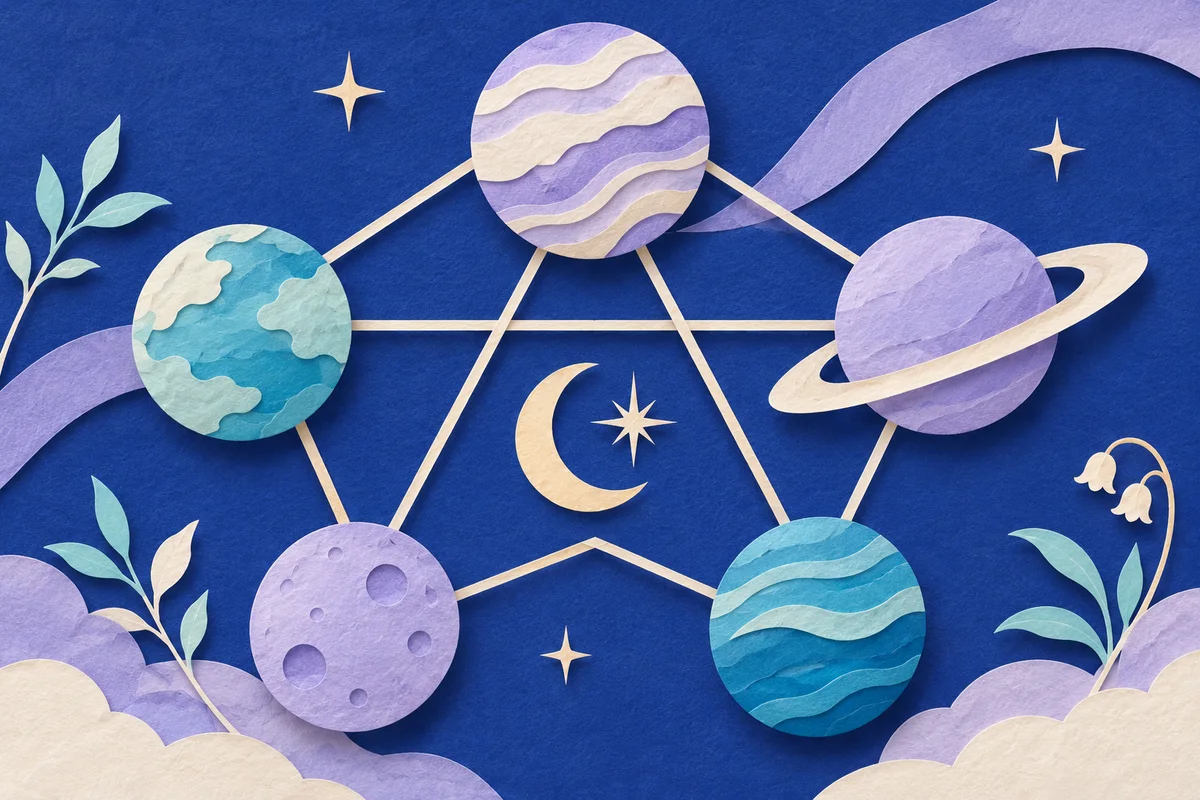
Five major aspects at a glance
More columns → Swipe sideways, or focus the table and use the arrow keys.
| Aspect | Exact angle | Common symbolic framing | A practical question |
|---|---|---|---|
| Conjunction | 0° | Themes meet or combine | How do these two functions operate together? |
| Sextile | 60° | An opening that may need participation | What would make the opportunity usable? |
| Square | 90° | Friction, adjustment or competing demands | What needs a different approach? |
| Trine | 120° | Ease or an established flow | What works so naturally that I overlook it? |
| Opposition | 180° | Polarity or a relationship between ends | How can I acknowledge both sides? |
Calculate the angle before the meaning
For two longitudes A and B, first find their absolute difference. If that number is greater than 180°, subtract it from 360° to get the shorter distance around the circle. Compare that distance with the aspect’s exact angle. The difference from the exact angle is the orb.
More columns → Swipe sideways, or focus the table and use the arrow keys.
| Teaching positions | Smaller separation | Result |
|---|---|---|
| 10° Aries and 13° Aries | 3° | Conjunction with a 3° orb |
| 10° Aries and 12° Cancer | 92° | Square with a 2° orb |
| 350° and 5° | 15° | Not a close conjunction under a 6° example limit |
An illustrative learning summary showing how to determine the distance between two celestial points and define the resulting aspect orb.
- Find Absolute Difference
Subtract the smaller longitude from the larger one. If the result exceeds 180 degrees, subtract that number from 360 to find the shorter distance.
- Determine the Orb
The orb is the absolute difference between the smaller separation and the aspect’s exact angle.
- Apply Aspect Limits
The positions 350° and 5° are 15° apart along the shorter arc, outside the example’s 6° conjunction limit.
There is no single universal orb table
Different tools and traditions use different orb allowances, sometimes varying by planet or aspect. In these examples, the 6° limit is a stated teaching assumption rather than a universal rule. An aspect 7° from exactness falls outside that assumption, though it could still appear on a chart with wider settings. Always check a chart’s orb settings before assuming a missing line is an error.
The same planets, a different relationship
Compare a hypothetical Mercury–Saturn conjunction with a hypothetical Mercury–Saturn square. The conjunction prompt asks how deliberation and communication work together; the square prompt asks where caution and expression pull against each other. Neither aspect measures intelligence, provides a diagnosis, or predicts the quality of someone’s work.
Mercury is at 40° and Saturn at 129°. Which major aspect is closest, and what is its orb?
Compare your answer +
Their separation is 89°, which is 1° from an exact square. Whether a chart draws that line depends on its display settings.
Applying and separating require motion information
A static angle alone does not tell you whether an aspect is tightening or separating. You also need each point’s direction and relative speed at that moment. Because planets can be retrograde, you cannot rely on a shortcut based only on which planet is usually faster. Use a chart service that explicitly labels applying and separating aspects rather than guessing from line color.
Use a small angular worksheet
Convert each position to a 360° longitude starting from 0°. In this teaching example, Aries starts at 0°, Taurus at 30°, and Cancer at 90°. That makes 10° Taurus equal to 40°, and 12° Cancer equal to 102°. Their separation is 62°, or 2° from an exact sextile. This arithmetic stays the same regardless of how an astrologer interprets the aspect.
For an example across sign boundaries, compare 29° Pisces (359°) with 1° Aries (1°). The shorter distance between them is 2°, even though they are in different signs. Conversely, two points in the same sign can be nearly 30° apart. A sign label by itself is never enough to calculate a degree-based aspect.
More columns → Swipe sideways, or focus the table and use the arrow keys.
| Your step | Question to answer | Example |
|---|---|---|
| Convert | What longitude does each sign-and-degree label represent? | 10° Taurus becomes 40° |
| Separate | Which route around the circle is shorter? | 359° to 1° is 2° |
| Compare | Which exact aspect angle is nearby? | 62° is near 60° |
| Apply a rule | Is the orb inside the stated allowance? | 2° is inside a 6° teaching limit |
| Interpret cautiously | What question does the symbolism suggest? | A prompt to explore, not an established fact |
What to do when two websites show different lines
First, check the numerical degree positions. If the degrees do not match, verify your birth data and coordinate settings. If the degrees match, compare which aspects each site includes and what orb limits it uses. One site may display only major aspects while another includes minor angles. Because line colors are just a site’s visual style, check each site’s legend instead of assuming a color means the same thing everywhere.
Note the exact setting difference you find. Writing “Both charts show the same degrees, but one uses a wider orb” explains the discrepancy clearly. Saying “One chart is more powerful” does not check the math. Once you know why the displays differ, you can pick one consistent set of rules for your study without treating that technical choice as proof of a personal prediction.
Do not confuse closeness with evidence
A smaller orb simply means two points are closer to an exact geometric angle; it does not make a personal interpretation more accurate. Keep these two things separate in your notes: you can verify an angle with arithmetic, whereas a claim about someone’s behavior requires real-world evidence. Precise degree numbers do not make an unproven statement about a person any more certain.